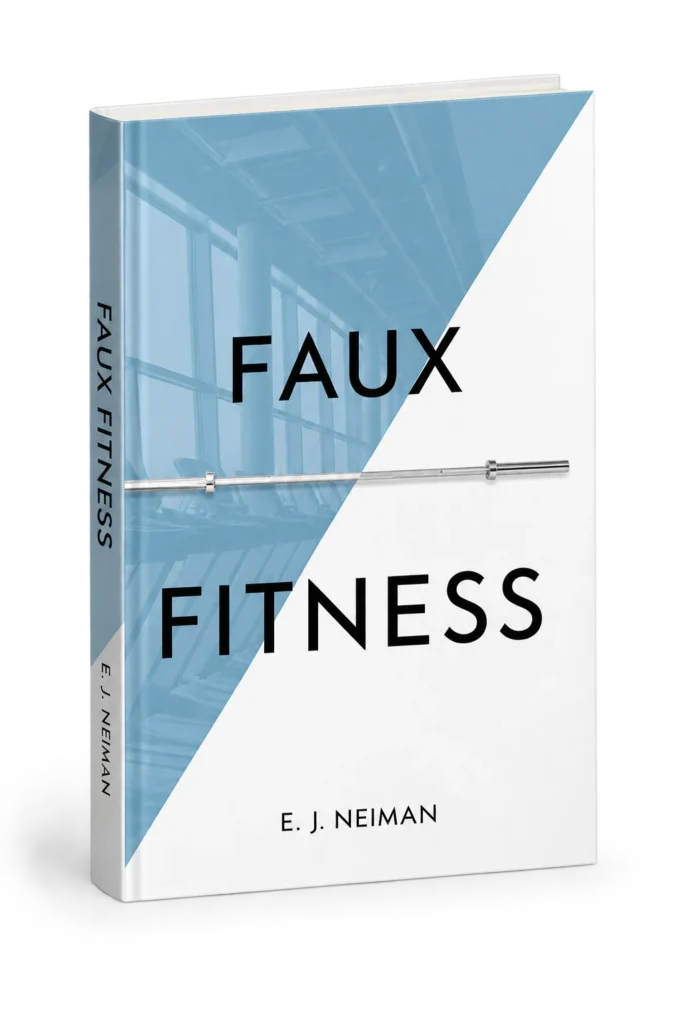
faux fitness
A user’s manual for how our bodies really work. Facts, a touch of science, and a dash of humor.
What you think you know about fitness may be wrong
Contrary to what we think we know, have learned, or have been told, Faux Fitness is a user’s manual for how our bodies really work.
It paints a clear picture of what health, fitness and well-being truly are, from the way we breathe and exercise to how we adapt, eat and recover.
It’s not what you do for exercise, it’s how you do it.

Ideas inside the book
Our bodies are meant to breathe
Aerobic and anaerobic describe how muscle cells make energy, not how hard you huff and puff.
There is no gain with pain
What if you could have a great workout without onset soreness?
Adaptation is our superpower
Your body finds the simplest way to do whatever you ask of it. So what are you asking?
What we don't know does affect us
Small facts about how the body works change how you train, eat and age.
Questions worth asking
Do we have to feel our age?
What if a grandparent could feel like a teenager again?
Are we truly healthy?
What if you could have a great workout without onset soreness?
Is “cardio” really healthy?
What about endorphins?
- Are they really healthy for us?
- Are they really considered a “feel-good” chemical?
Is our food truly healthy?
What about cholesterol?
What about heart disease?
It’s not what you do for exercise; it’s how you do it?
Our bodies are meant to breathe?
There is no gain with pain?
What we don’t know will affect us?
Questions worth asking
To breathe or not to breathe
People love running, whether it be for sport, exercise (weight loss), fresh air, the rush of endorphins, or the energy that comes from it. Regardless of which group you find yourself in, you might want to sit down for this next part.
Aerobic and anaerobic aren't about how much air you take in. They describe the two ways your muscle cells make energy.
Aerobic
Below 120 bpm
The body delivers air to muscle cells to burn fat as fuel. The by-product is sweat, or water.
Anaerobic
Above 120 bpm
Muscle cells don’t get enough oxygen, so the body burns glycogen through glycolysis. The by-product is lactic acid. This is oxidative stress.
Can you think of any other mammal that willingly keeps its heart rate elevated for any period of time?
There isn't one. Not one. We are the only species on Earth that does this.
Adaptation. Whatever we ask our bodies to do, We get better at it.
Cold and heat
People from cold climates walk around at 32ºF (0ºC) in a T-shirt. Put someone from the desert there and they freeze, at much warmer temperatures. Our species lived through an ice age.
Strength and food
Lift something heavy over and over and we become stronger. Eat more food and we gain weight.
New skills
Learn a sport, music, dance, balancing or driving, and the body builds new neural and arterial pathways until it gets easier.
A thought experiment
Imagine being stuck in a room with very little oxygen for at least 20 minutes. Would you take deep breaths, filling your lungs with as much air as you can? Or would you breathe as little as possible, teaching your body to use less and less oxygen? If you chose the latter, you would be correct.
Get Faux Fitness
Audiobook (coming soon)
Coming soon. Get an email when it is ready for download.

Meet Neiman
E. J. Neiman is the author of Faux Fitness, a refreshingly honest guide that challenges conventional health and exercise ideologies. With a unique blend of humor, practical insight, and real-world wellness strategies, Neiman helps readers better understand how the human body truly works.
His approach focuses on reducing pain and soreness, managing stress, improving sleep, and making simple lifestyle changes that create lasting results. Through his work, Neiman empowers people of all ages to rethink fitness, optimize wellness, and unlock a healthier, more energized life.
Testimonials
Lorem ipsum dolor sit amet, consectetur adipiscing elit. Ut elit tellus, luctus nec ullamcorper mattis, pulvinar dapibus leo.

John Doe
Lorem ipsum
Lorem ipsum dolor sit amet, consectetur adipiscing elit. Ut elit tellus, luctus nec ullamcorper mattis, pulvinar dapibus leo.

Samantha Taylor
Lorem ipsum
Lorem ipsum dolor sit amet, consectetur adipiscing elit. Ut elit tellus, luctus nec ullamcorper mattis, pulvinar dapibus leo.

Kristin Watson
Lorem ipsum
Lorem ipsum dolor sit amet, consectetur adipiscing elit. Ut elit tellus, luctus nec ullamcorper mattis, pulvinar dapibus leo.
John Doe
Lorem ipsum
Lorem ipsum dolor sit amet, consectetur adipiscing elit. Ut elit tellus, luctus nec ullamcorper mattis, pulvinar dapibus leo.
Samantha Taylor
Lorem ipsum
Lorem ipsum dolor sit amet, consectetur adipiscing elit. Ut elit tellus, luctus nec ullamcorper mattis, pulvinar dapibus leo.
Kristin Watson
Lorem ipsum